
Updated: Aug, 2026 | By Mr. David
The Ultimate Local SEO Checklist for 2026: Complete Guide
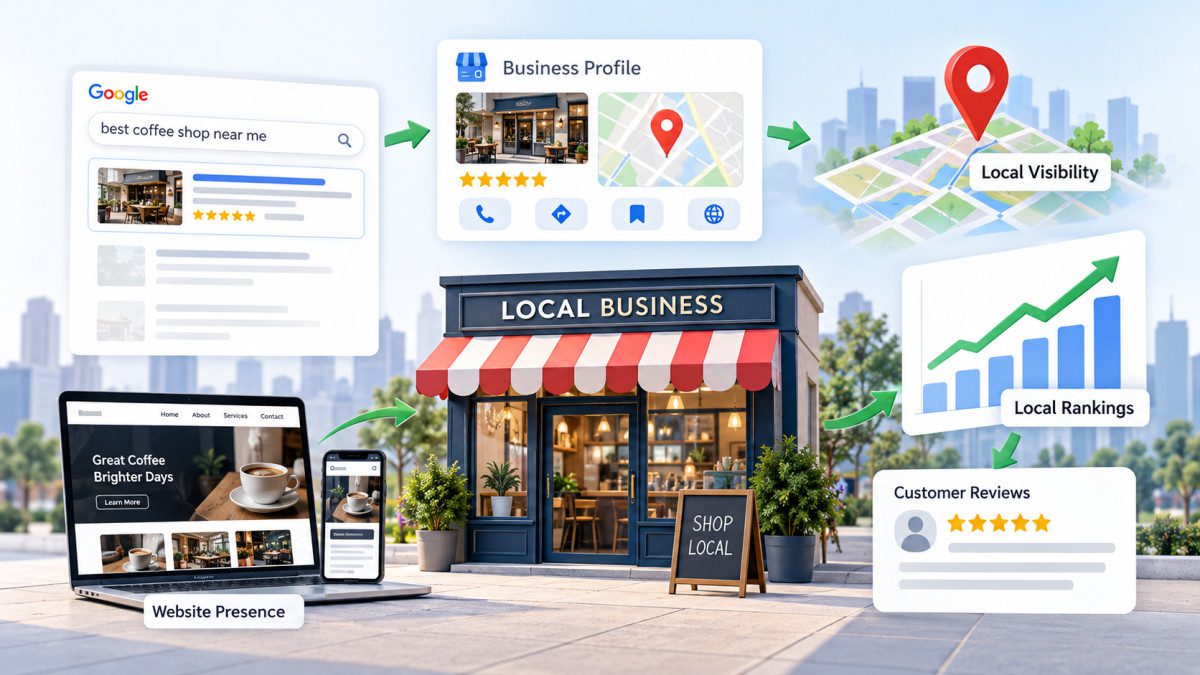
A local SEO checklist helps improve local search optimization, strengthen local search rankings, and turn Google Business Profile visibility into local customers. Local SEO guide 2026 covers ranking factors, Google Maps SEO, location-based SEO, local marketing, and local organic traffic.
Use this local SEO checklist as a practical roadmap for stronger local search optimization, better local rankings, and greater local visibility. It connects Google Business Profile, Google Maps, search intent, and SEO best practices with measurable local business growth, helping small businesses attract qualified local customers through a structured 2026 local SEO process and actionable checklist for ongoing improvements across priority service areas.
What is a Local SEO Checklist?
A local SEO checklist is a step-by-step framework for improving a business’s visibility in Google Maps, local search results, and relevant local discovery platforms. It typically covers Google Business Profile optimization, local keyword research, website and location-page optimization, citations and NAP consistency, customer reviews, local links, technical SEO, structured data, performance tracking, and ongoing maintenance. In 2026, a complete checklist can also include practical preparation for AI-powered search experiences by making local business information clear, consistent, authoritative, and easy for search systems to understand.
Quick Checklist Summary (Jump Navigation)
Use this roadmap to move through the local SEO checklist in the right order. Start with your business and Google Business Profile foundations, then optimize your website, local content, citations, reviews, authority, technical SEO, and measurement before moving into AI search and ongoing maintenance.
Table of Contents
ToggleWhat Is Local SEO?
Local SEO, or local search optimization, improves a business’s visibility when people search for products, services, or places in a specific area. It combines location-based SEO, local search marketing, Google Business Profile optimization, Google Maps SEO, website improvements, and reputation signals to strengthen local search rankings. The goal is stronger local business visibility across the local search ecosystem, including proximity search and local organic search. Effective work aligns geographic relevance with customer needs, helping eligible businesses appear during local decision-making and discovery in competitive markets. This supports sustainable local customer acquisition when business information is accurate, useful, and aligned with genuine search demand today.
Local SEO Explained
A practical local SEO definition is search engine optimization designed to connect local customers with relevant businesses through local search results. Google Business Profile, local SERPs, nearby searches, and Maps results rely on local intent, location signals, geographic targeting, relevance, proximity, and prominence to support business visibility. Done well, local business discovery can improve customer acquisition across organic local listings for relevant service searches today for local businesses and customers consistently.
In simple terms: Local SEO helps search engines connect a business with relevant searches in the geographic areas it serves.
✅ A complete local SEO strategy typically works across:
- Google Business Profile and Google Maps
- Local organic website results
- Local citations and directories
- Customer reviews and reputation
- Location and service pages
- Local links and mentions
- Structured business information

(Credit: Mr. David)
Local SEO vs Traditional SEO
A practical local SEO definition is search engine optimization designed to connect local customers with relevant businesses through local search results. Google Business Profile, local SERPs, nearby searches, and Maps results rely on local intent, location signals, geographic targeting, relevance, proximity, and prominence to support business visibility. Done well, local business discovery can improve customer acquisition across organic local listings for relevant service searches today for local businesses and customers consistently.
Traditional SEO focuses primarily on improving a website’s visibility for relevant searches, while local SEO adds geographic relevance and business-location signals for searches connected to a specific area.
Local SEO vs traditional SEO prioritizes local intent and geographic targeting, while national SEO and global SEO pursue organic rankings. Local work emphasizes proximity signals, Google Maps, Local Pack, location pages, service area targeting, and entity relevance, creating ranking differences.
| Area | Traditional SEO | Local SEO | Primary focus | Organic search visibility | Local visibility + organic search |
|---|---|---|
| Search intent | Informational, commercial, transactional | Local, commercial, transactional |
| Geographic relevance | May be secondary | Often central |
| Google Business Profile | Not essential for every site | Core asset for eligible businesses |
| Google Maps | Usually not central | Major local discovery surface |
| Citations | Usually limited relevance | Important for local business information |
| Reviews | Trust/conversion signal | Important local reputation signal |
| Location pages | Usually unnecessary | Often useful when genuinely needed |
| Local links | Helpful but not always essential | Valuable local authority signal |
| Main outcomes | Organic traffic | Local visibility, calls, visits, leads, sales |
How Local Search Works in 2026
A user makes a local query; systems interpret intent and geographic context, assess business relevance, then return eligible results. Relevance, distance, prominence, entity understanding, Google Business Profile signals, and search context can shape results. Semantic search, information retrieval, personalized search, and local intent detection help systems interpret context and connect businesses with searchers. These systems also weigh local ranking factors for eligible results. today locally.
Search systems may combine multiple business signals to understand identity, category, services, location, website content, reviews, citations, and prominence or reputation. Entity understanding helps connect these facts across sources rather than treating every page as isolated. Google Business Profile signals, knowledge graph relationships, and real-world signals can contribute to how a business is interpreted within a broader local search context. Search systems can consider semantic relationships, behavioral signals, and information retrieval evidence.
The visible result can include the Local Pack, Google Maps, organic results, branded or local queries, and service plus location searches. A user performs a relevant search; systems interpret intent and context, evaluate business and website information, then present eligible results. The user may visit, call, book, request directions, or continue researching through other search features. Personalized search, AI Overviews, semantic search, and local intent detection can alter which results are surfaced.
How does local search work?
Local search works by matching a user’s query and geographic context with businesses and web pages that appear relevant to the search. Search systems can consider information about the business, its location, category, services, website, reputation, and other signals before presenting local and organic results.
Process List:
1. A user performs a local or geographically relevant search.
2. Search systems interpret the query and geographic context.
3. Relevant business and website information is evaluated.
4. Eligible local and organic results are presented.
5. The user chooses an action such as visiting, calling, booking, or requesting directions.
Local Pack, Google Maps & Organic Results
The Local Pack is a prominent local search feature that groups relevant business listings for a query, often showing names, categories, reviews, and location details. It connects Google Business Profile information with map pins and supporting signals, helping users compare nearby options and act quickly when local intent is clear. For many searches, it provides concise decision support without requiring a website visit.
Google Maps results help users discover businesses through map rankings, local listings, business profiles, reviews, local citations, and map pins. Strong location relevance can support visibility for people seeking nearby options, with actions such as navigation intent, click-to-call, and direction requests making Maps particularly useful for location-driven searches and destination choices. These actions support nearby customer decisions for nearby customers efficiently reliably.
Local organic results are the non-map website listings that can appear for geographically relevant searches. They depend on organic search results, website relevance, localized content, local citations, reviews, and broader search signals. A business can therefore pursue local visibility beyond map rankings, especially when users need detailed information before contacting or visiting, comparing services, or evaluating credibility before making a local purchase decision with confidence.
| Search Surface | What Users See | Business Information | Main Optimization Areas |
|---|---|---|---|
| Local Pack | Local business listings in Google Search | Name, category, reviews, location, hours, etc. | GBP, relevance, distance, prominence |
| Google Maps | Map-based local business discovery | Business profile, location, directions, reviews, photos, services | GBP, location accuracy, reputation, relevance |
| Local Organic Results | Web pages relevant to local searches | Page title, URL, content, snippets | On-page SEO, local content, technical SEO, links |
Why Local SEO Matters More Than Ever
People increasingly use search to find nearby businesses, services, products, and physical locations because search can quickly connect a need with available options. Near me searches, mobile search, and navigation-oriented queries often reflect immediate local intent. For local companies, being discoverable at this stage can influence the customer journey, but visibility still depends on relevance, local competition, user location, and search context when customers compare options in real time. Search behavior can also include voice search and high-converting searches, although visibility varies by query, device, market, and business type locally when needed.
Local visibility can contribute to calls, visits, bookings, leads, sales, directions, and website visits when the business matches the searcher’s needs and offers a credible next step. Local customer acquisition is therefore a practical objective, but rankings alone do not guarantee revenue. Conversion quality, purchase intent, service fit, pricing, reviews, trust signals, follow-up, and customer experience all affect local conversions and lead generation. The strongest outcomes require a relevant offer and credible customer experience over time; pricing, service quality, availability, competition, and follow-up still influence revenue for each business in practice consistently.
In 2026, local businesses need useful and consistent information across search, Maps, their website, directories, reviews, and emerging AI-assisted discovery. AI-powered search may introduce additional discovery paths, but its behavior can change and should not be treated as a guaranteed ranking channel. Businesses should prioritize accurate information, review signals, brand authority, EEAT, online visibility, and a coherent customer journey across omnichannel discovery while keeping AI claims measured and testable. Accurate profiles also strengthen credibility and trust across the customer journey, rather than relying on one discovery channel, while monitoring performance and feedback.
Why is local SEO important?
Local SEO matters because people often use search engines to find businesses, services, and products in a specific area. Strong local visibility can help a business appear in relevant local results, Maps experiences, and organic searches, increasing opportunities for calls, visits, bookings, website visits, and other customer actions.
Who Needs This Local SEO Checklist?
A local SEO checklist is useful for any local business that depends on local search visibility to attract local customers, calls, visits, or enquiries. It gives local business marketing a framework for managing Google Business Profile, Google Maps presence, location-based marketing, local lead generation, and local rankings. For a small business, it can turn scattered optimization into a practical local search strategy tied to business growth. For larger organizations, it helps coordinate industry-specific SEO and regional search optimization across locations. The right checklist also helps identify gaps in relevance, prominence, proximity, reviews, content, and technical foundations before resources are invested in tactics that do not match the business model or search behavior.
Local Service Businesses
Local service businesses need this local SEO checklist because customers search for a provider when they have an immediate problem or appointment need. Plumbers, electricians, HVAC companies, roofing contractors, locksmiths, landscapers, cleaning services, home services, legal services, dental practices, and medical clinics can use it to strengthen Google Business Profile optimization, call generation, local customer acquisition, and proximity searches. For a service area business (SAB), the checklist also helps align service regions, coverage information, reviews, and landing pages without misrepresenting an address. The priority is not simply higher rankings; it is converting relevant local leads into calls, enquiries, appointment bookings, and jobs while maintaining accurate business information across important local search surfaces.
Who needs a local SEO checklist?
Local service businesses often benefit substantially from local SEO because customers commonly search for specific services in a particular area. Businesses such as plumbers, dentists, electricians, contractors, lawyers, and repair companies can use local search visibility to generate calls, enquiries, appointments, and website visits.
Priorities for local service businesses:
🔧 Google Business Profile optimization
📞 Call generation
📍 Proximity searches
🏠 Service area optimization
⭐ Customer reviews
📅 Appointment bookings
🎯 Local customer acquisition
Brick-and-Mortar Stores
Brick-and-mortar stores benefit from a local SEO checklist when locations depend on foot traffic, in-store visits, and nearby searches. Retail locations should optimize their storefront information, Google Maps visibility, store locator, opening hours, directions, customer reviews, and map listings so local shoppers can discover and reach them. Retail SEO should also connect local inventory, local promotions, and location-specific pages with purchase intent. The objective is location-based discovery that supports walk-in customers, not merely website traffic. A retailer with several branches should maintain accurate information for each location while preserving a consistent brand experience. This approach makes Google Business Profile signals, local relevance, and real-world availability useful to customers deciding where to buy consistently.
Does a physical store need local SEO?
Yes. A physical store can use local SEO to improve its visibility when nearby or location-specific searches lead customers to Google Search, Google Maps, or the business website. Accurate business information, relevant categories, reviews, useful website content, and a strong local presence can all support discovery and customer decision-making.
Priorities for brick-and-mortar businesses:
🏪 Physical storefront optimization
📍 Google Maps visibility
🚶 Foot traffic and walk-in customers
🛒 Local inventory
🕐 Opening hours
⭐ Customer reviews
🧭 Directions
🏷️ Local promotions
🔎 Nearby searches
Multi-Location Businesses
Multi-location businesses should use this local SEO checklist when multiple locations need visibility without losing location-specific relevance. Every business location should have accurate information, including its address, phone, hours, services, and signals. Franchise locations, branch management, and enterprise local SEO require consistency. A centralized brand can establish governance while each location receives localized optimization based on its market, services, and customer needs. The goal is scalable SEO supporting regional targeting and citations.
A scalable architecture should connect the brand with each business location without treating every city as a separate campaign. Model: Business → Location → Google Business Profile → Location Page → Local Signals structure. Location pages should provide useful local landing pages with unique services, staff, amenities, directions, or reviews relevant to that branch. Do not create identical city pages with swapped city names. Duplicate prevention protects quality while allowing branch management to scale.
For multi-location businesses, the workflow can be visualized as a system: the centralized brand sets standards; each business location supplies verified details; its Google Business Profile represents the real-world branch; the matching location page explains local value; and local signals reinforce relevance, authority, and citation consistency. This structure supports regional visibility without unnecessary duplication. It also makes Google Business Profile management, location-specific SEO, local rankings, and monitoring easier to govern as the organization expands across markets.
Architecture Diagram:
Centralized Brand
↓Business Location
↓Google Business Profile
↓Location Page
↓Local Signals
↓Local Rankings & Regional Visibility

(Credit: Mr. David)
Does a physical store need local SEO?
Yes. A physical store can use local SEO to improve its visibility when nearby or location-specific searches lead customers to Google Search, Google Maps, or the business website. Accurate business information, relevant categories, reviews, useful website content, and a strong local presence can all support discovery and customer decision-making.
Key Priorities:
🏢 Multiple locations
📍 Location-specific SEO
🗺️ Google Business Profile management
📄 Local landing pages
🔄 Consistent NAP
🧩 Duplicate prevention
🏷️ Citation consistency
📈 Regional visibility
⚙️ Scalable SEO
Service Area Businesses (SAB)
A service area business (SAB) should use this local SEO checklist when customers are served at their locations rather than a storefront. Mobile businesses, field service companies, appointment-based services, and operators can use it to define a realistic radius, coverage areas, and regions around the markets they serve. An eligible business can hide its business address on Google Business Profile when it does not receive customers there, rather than publishing an address to influence rankings. The checklist should align geographic targeting, service locations, local landing pages, and supporting signals with genuine customer locations and local intent. The goal is stronger map visibility among nearby customers without overstating service coverage or creating misleading claims. Accurate service regions should reflect actual operations, not ranking ambitions. transparently.
What is a Service Area Business (SAB)?
A Service Area Business is a business that serves customers at their locations rather than relying primarily on customers visiting a storefront. Examples can include plumbers, electricians, mobile repair services, cleaners, and contractors. Its local SEO strategy should accurately represent the areas it serves without creating misleading location signals.
SaaS Companies with Local Offices
SaaS companies can use this local SEO checklist when regional offices create local search opportunities for B2B local SEO, regional demand generation, or market expansion. A legitimate office location may support a Google Business Profile, an office listing, and a useful local landing page explaining the location and its role. However, companies should not manufacture local authority by creating thin location-specific content for offices that provide no meaningful function. Localized marketing connects regional search intent with useful information, local brand visibility, customer acquisition, and local organic traffic. Local SEO is most valuable when regional demand is real and the office represents an authentic business presence, based on measurable regional demand and evidence.
Does a SaaS company need local SEO?
A SaaS company does not automatically need a full local SEO strategy simply because it has a website. Local SEO becomes more relevant when the company has legitimate offices, regional teams, local sales operations, physical locations, or location-specific customer demand. In those cases, local business information and location-specific pages can support discovery.
Bloggers & Affiliate Businesses Targeting Local Keywords
Bloggers and affiliate marketers targeting local keywords can use this local SEO checklist when their model depends on city-specific content, regional strategy, or location-based guides. Local affiliate SEO supports travel blogging, local recommendations, neighborhood content, and local resource pages when the publisher has topical authority and useful information for a defined place. Unlike a storefront, a publisher may not need a Google Business Profile because it writes about a city. Focus on local search intent, informational queries, semantic SEO, organic traffic, and geo-targeted content answering real questions. Strong local content clusters build search visibility when pages are original, useful, connected, and differentiated rather than mass-produced city variations for users and search engines.
Can bloggers use local SEO?
Yes. Bloggers and publishers can use local SEO principles when their content satisfies location-specific search intent, such as city guides, neighborhood resources, local comparisons, and location-based recommendations. However, publishing local content does not by itself make a site eligible for a Google Business Profile; the business-profile strategy depends on the site’s actual business type and eligibility.
Agencies Managing Local SEO
SEO agencies and digital marketing agencies should use this local SEO checklist to standardize local SEO campaigns across clients without making optimization one-size-fits-all. A workflow can connect local SEO audits, technical SEO, local content strategy, Google Business Profile management, citation management, review management, rank tracking, competitive analysis, and multi-client reporting. Agencies should adapt the workflow to each client’s market, business model, and competitive landscape. White-label SEO teams can use these controls for delivery and reporting, while client management teams can use documented processes to improve transparency. The checklist is most valuable when it defines quality standards, ownership, evidence, and reporting rather than promising identical outcomes for every location consistently.
What should agencies include in a local SEO workflow?
A local SEO agency workflow should typically include an initial audit, business and search-intent analysis, Google Business Profile and website optimization, citation and reputation management where relevant, local content and authority development, performance tracking, reporting, and ongoing maintenance.
Workflow:
Local Keyword Research → Local SEO Audit → GBP Management → Citation Management → Local Content → Review Management → Rank Tracking → Reporting → Optimization
| Business Type | Primary Local SEO Focus |
|---|---|
| Local service business | GBP, services, reviews, service-area relevance, leads |
| Brick-and-mortar | GBP, Maps, location information, reviews, visits |
| Multi-location | Location entities, GBP management, location pages, scalability |
| Service Area Business | Accurate service areas, GBP, service pages, reputation |
| SaaS with local offices | Genuine local presence, office information, regional demand |
| Blogger / affiliate | Local organic content, entities, local search intent |
| SEO agency | Repeatable audits, implementation, measurement, reporting |
Who Should Not Prioritize This Checklist?
A business should not blindly apply every local SEO tactic simply because it serves customers in a geographic market. A purely national or global online business with no legitimate local presence may gain little from location-specific Google Business Profile or map optimization. Likewise, creating artificial addresses, duplicate city pages, or misleading service locations is not a sound alternative. The checklist is worth implementing when local search intent, a legitimate business presence, and measurable customer demand justify the work.
(Credit: Mr. David)
Complete Google Business Profile (GBP) Checklist
Google Business Profile is one of the most important local-search assets for an eligible business because it controls how core business information can appear across Google Search and Google Maps. A complete profile gives customers clearer information about what you offer, where you operate, when you are available, and how they can contact you. GBP optimization should therefore focus on business information accuracy, profile completeness, relevance, customer experience, and conversion opportunities rather than simply adding keywords. Claiming and verifying the listing establishes business ownership, while accurate categories, services, attributes, photos, hours, and contact details strengthen the profile’s local search presence. For a local business competing in the US, UK, Canada, or Europe, systematic business profile optimization creates a reliable foundation for Google Maps visibility and local conversions.
What is Google Business Profile?
Google Business Profile is a Google service that allows eligible businesses to manage how their business information appears on Google Search and Maps, including details such as business name, category, location, hours, website, photos, services, and customer-facing features.
Claim & Verify Your Business
Start by claiming the Google Business Profile that represents your actual business rather than creating another listing when an eligible listing already exists. Confirm the business name, business location or service area, website, and ownership access before beginning verification. Google may offer different verification methods depending on the business and account, including postcard verification, phone verification, email verification, or video verification; the available method is determined by Google. Verification establishes business ownership and helps activate management access to the Google Maps listing. For agencies, ownership access should remain with the actual business, with appropriate account security and manager permissions for other users. Never create duplicate profiles simply because verification is inconvenient. A verified business should accurately represent a real business identity and maintain its information after activation.

(Credit: Mr. David)
How do I claim and verify a Google Business Profile?
Start by finding or adding the eligible business on Google Business Profile, follow Google’s verification process, and complete the requested verification steps. If a profile already exists, follow Google’s process for requesting access or ownership rather than creating a duplicate listing.
Choose the Right Primary & Secondary Categories
Category selection is a classification decision, not a keyword-stuffing exercise. Choose the primary category that most accurately describes the business’s main activity, then add relevant secondary categories only when they genuinely represent important services or business functions. Google Business Profile categories help establish business classification, entity classification, and topical relevance, which can affect how Google matches a listing with searches. For example, a dental clinic should not choose a generic category simply because it has greater perceived search volume if a more specific dental category accurately describes the business. Category optimization should reflect the business niche, service offerings, local relevance, and actual business type. Review categories periodically when the business changes, but do not repeatedly switch categories merely to chase ranking signals.
Do: Choose the most accurate primary category and relevant secondary categories that genuinely describe the business.
Don’t: Add unrelated industry categories, competitor-oriented categories, or categories solely because you believe they contain high-value keywords.
How should you choose Google Business Profile categories?
Choose the primary category that most accurately represents the business’s main offering. Add secondary categories only when they genuinely describe additional aspects of the business. Categories should reflect the real business rather than being selected solely to target unrelated keywords.
Optimize Every GBP Section
Treat profile completeness as a quality-control process rather than a one-time checkbox exercise. Complete the business description, services, products where relevant, business attributes, opening hours, logo, cover photo, contact details, website URL, and appointment links where supported and appropriate. Then compare the profile with the business’s real-world information so customers receive consistent information before they visit, call, book, or purchase. Strong profile optimization also considers customer experience, local relevance, trust signals, conversion optimization, and entity completeness. A retailer may prioritize products and inventory-related information, while a professional service firm may gain more practical value from services, appointment links, credentials, and accurate business information. Review every section after major operational changes, seasonal changes, relocation, new services, or changes in customer access.
What should a complete Google Business Profile include?
A complete profile should accurately represent the business’s identity, category, services, location or service area, hours, contact details, visual assets, and other relevant customer-facing information available through the profile.
Business Description
Use the business description to explain what the company does, whom it serves, and what makes its offering useful instead of turning the field into a keyword list. A strong business description communicates the business overview, unique value proposition, major service offerings, relevant specialties, and geographic relevance in natural language. Include local keywords only where they genuinely describe the business, because forced repetition can reduce readability without creating a meaningful ranking advantage. The description should reinforce brand identity and semantic relevance while demonstrating practical expertise and experience where appropriate. A local SEO agency, for example, can explain its services, target businesses, market experience, and approach rather than inserting every city name it wants to rank for. Keep the message concise, customer-focused, accurate, and consistent with the website and other business information.
What should a Google Business Profile description include?
A GBP description should clearly explain what the business does, the products or services it offers, and useful information that helps customers understand the business. It should be natural, accurate, and written for customers rather than filled with repeated keywords.
Services
Build the services section around the actual solutions customers can purchase or request. Add primary services first, followed by meaningful secondary services, and use clear service descriptions that explain what each service involves. Where Google’s interface supports pricing information, service availability, or related details, keep them accurate rather than using speculative figures. Service keywords can appear naturally in service names and descriptions when they reflect genuine offerings. A London accountant, for example, could distinguish tax returns, bookkeeping, payroll, and business accounting instead of placing every phrase into one generic service entry. This creates stronger semantic coverage because Google and customers can understand individual customer solutions. Review the catalog whenever services change, and remove discontinued offerings so conversion intent, service relevance, and localized services remain aligned.
What services should I add to my Google Business Profile?
Add the actual services the business provides and that are relevant to the selected business category.
Products
Products are particularly useful for retailers and businesses where customers evaluate tangible offerings before visiting or purchasing. Add relevant products to the product catalog when the feature is available and appropriate, using accurate product descriptions, product images, categories, pricing, and availability information. Featured products should represent genuine business offerings rather than unrelated keyword targets. A local furniture retailer, for example, can highlight major product categories or representative products that help customers understand its range and shopping intent. Product optimization should support product visibility and customer purchases without implying inventory that the business does not actually carry. Service businesses that do not sell products do not need to manufacture a product catalog merely for completeness. Relevance matters more than filling an irrelevant field.
Should every business add products to its GBP?
No. Product features should be used when they accurately represent what the eligible business offers.
Attributes
Use business attributes to communicate factual characteristics that matter to customers. Depending on the business and Google’s available options, attributes can describe accessibility features, amenities, payment methods, service options, or characteristics such as wheelchair accessible, women-owned, veteran-owned, LGBTQ+ friendly, Wi-Fi availability, outdoor seating, delivery, takeout, dine-in, or appointment required. Select only attributes that accurately describe the business. These details can reduce friction for customers who need specific facilities or service conditions before visiting. For example, a restaurant should keep dine-in, takeout, delivery, and outdoor seating information accurate because customers may use these characteristics when choosing between local options. Attributes are useful for customer convenience and profile completeness, but they should never be invented for perceived ranking benefits.
What are Google Business Profile attributes?
Attributes are profile details that communicate specific characteristics or features of a business, helping customers understand what the business offers or what facilities/features may be available.
Opening Hours
Accurate opening hours are a basic local-search trust requirement because customers often make decisions immediately after finding a business. Maintain regular hours and update holiday hours, special hours, seasonal hours, and temporary operating changes when applicable. A restaurant that closes early on a public holiday but leaves its normal schedule unchanged can create a poor customer experience even if its rankings remain unaffected. Check the Google Business Profile hours against the website, storefront signage, booking system, and actual operating schedule. Emergency hours or temporary closures should be handled promptly when relevant. The objective is profile accuracy and business availability, particularly for time-sensitive searches. Weekend hours deserve the same attention as weekday hours. Review the schedule before major holidays, seasonal changes, and operational changes.
Why should GBP opening hours be accurate?
Because customers rely on them to determine whether a business is open and when they can visit, call, or receive services. Incorrect hours can create a poor customer experience and undermine trust.
Business Logo
Use a recognizable, high-resolution business logo that represents the same brand customers encounter on the website, storefront, packaging, or other official channels. A square logo generally works well for profile branding because it remains recognizable when displayed in smaller spaces. Avoid blurry images, excessive text, promotional banners, or designs that become unreadable at reduced sizes. Consistent visual branding strengthens brand recognition and helps customers connect the Google Business Profile with the real business identity. For a multi-location company, maintaining consistent logo quality across locations can also improve visual consistency. Logo optimization is therefore primarily a branding and trust exercise rather than a direct ranking tactic. A professional appearance, recognizable branding, and strong business credibility make the profile easier for customers to identify and trust.
Cover Photo
Choose a cover photo that accurately communicates the business environment and gives customers a realistic first impression. Depending on the business, this could be an authentic storefront image, business exterior, interior, workspace, or another relevant featured image. A restaurant might show its dining environment, while a clinic could show its professional reception area or exterior. Avoid stock imagery that misrepresents the location or creates unrealistic customer expectations. High-quality profile visuals can improve visual engagement and location recognition because customers can connect the listing with the physical business environment. Keep images current when the storefront, interior, branding, or customer experience changes. The cover photo should support profile optimization through visual trust and business authenticity, not through hidden keyword tactics.
What should a Google Business Profile cover photo show?
It should represent the business accurately and provide useful visual context for customers, using an appropriate, high-quality image that reflects the real business.
Add High-Quality Photos & Videos
Visual evidence can answer questions that written business information cannot, so maintain a useful library of authentic business photos and videos. Include storefront photos, interior photos, exterior photos, team photos, product photos, and service photos according to what the business actually offers. Restaurants can show dining areas and representative dishes; contractors can show completed projects; retailers can show products and store interiors; professional offices can show reception areas and team members. Prioritize image quality, authenticity, local relevance, and updated media over artificial image manipulation. Video walkthroughs can also demonstrate the customer environment where appropriate. Avoid treating geotagged images as a guaranteed ranking tactic; accurate, useful media matters more than metadata myths. Refresh outdated images so profile freshness reflects the current customer experience.

(Credit: Mr. David)
Photo & Video Checklist
📍 Location: Show authentic storefront and exterior photos.
🏢 Interior: Help customers recognize the business environment.
👥 Team: Introduce real staff where appropriate.
🛍️ Products: Display representative products and offerings.
🛠️ Services: Demonstrate completed work or service experiences.
🎥 Video: Use useful walkthroughs or demonstrations when appropriate.
🔄 Freshness: Replace outdated media when the business changes.
What photos should a local business add to Google Business Profile?
Add clear, authentic images that help customers understand the business, such as its exterior, interior, products, services, team, facilities, or completed work where relevant. Use current, accurate images rather than generic stock photography.
Build an Effective Q&A Section
Use Google Q&A to address recurring customer questions that can otherwise create uncertainty before a visit or purchase. Focus on questions involving services, business policies, appointment requirements, pricing questions, parking, accessibility, operating conditions, or other legitimate customer concerns. Where the platform allows the business to provide owner responses, answer clearly and accurately rather than inserting promotional keyword phrases. This approach aligns the Q&A section with local search intent and conversational queries, which are increasingly useful for customers seeking direct information. Review questions periodically because inaccurate or outdated answers can damage trust. Think of proactive answers as customer education: they clarify the business and reduce friction. Q&A can support profile completeness, trust building, customer engagement, and answer optimization, but it should not be treated as a guaranteed ranking lever.
Publish Google Posts Consistently
Use Google Posts when the feature is available to the profile and the business has genuinely useful information to communicate. Rotate between relevant profile updates, local promotions, business announcements, event promotion, seasonal updates, business news, offer posts, and update posts rather than publishing repetitive keyword-focused content. A practical posting schedule depends on how frequently the business has meaningful news; there is no universally valid number of posts per week that guarantees better local rankings. For a retail business, seasonal promotions may be useful, while a professional practice might prioritize announcements and educational updates. Every post should have a clear purpose and accurate information. Treat content consistency as local marketing and customer communication, not as a mechanical ranking hack.
How often should a business publish Google Business Profile posts?
There is no universal frequency that guarantees better rankings. Recommend a sustainable publishing schedule based on whether the business has genuinely useful updates to share.
Offers
Create offers only when the business has a genuine promotion that customers can use. State the discount, special promotion, coupon, or limited-time offer clearly, and include a useful call-to-action where supported. Seasonal deals can work well for retailers, restaurants, and service businesses, but the offer validity must be accurate so customers do not arrive expecting an expired promotion. Connect promotional messaging with a real customer acquisition objective: for example, a local salon might offer a valid service discount for new customers, while a retailer might promote a seasonal product bundle. Avoid exaggerated claims or permanent “limited-time” language. The purpose of offer visibility is to communicate a legitimate purchase incentive and support conversion optimization, not to manipulate rankings through promotional keywords.
Events
Use event posts for genuine local events, workshops, webinars, grand openings, community events, seasonal events, or other business activities that customers can actually participate in. Include accurate event dates, useful descriptions, and registration links where supported and appropriate. A local fitness studio could promote a scheduled workshop, while a retailer might announce a community event or product demonstration. Event promotion becomes more valuable when the event itself is relevant to the local audience rather than being created solely for search visibility. Keep event announcements current and remove or update outdated information. Consistent event communication can support local engagement, event visibility, community involvement, customer participation, and profile freshness without turning the profile into a stream of artificial promotional content.
Updates
Use update posts for timely information that customers genuinely need, such as business news, company announcements, operational updates, service changes, product launches, holiday announcements, or meaningful business improvements. A clinic changing appointment procedures, for example, can use an update to explain the new process clearly. A retailer launching a new product line can communicate the change with accurate customer-facing information. Avoid publishing generic statements solely to create activity. Useful content updates should answer a real customer question or communicate a meaningful change. Review older announcements so the profile does not leave customers with contradictory information. Timely information supports customer communication, ongoing activity, profile maintenance, and trust signals more effectively than repetitive posts with no substantive value.
Messaging & Booking Features
Make the customer action flow as short and clear as possible when messaging or booking features are available and appropriate for the business. Customers may discover a listing, review the service information, ask a question, and then contact or book the business. Google messaging, click-to-message options, appointment booking, online scheduling, and booking integrations can reduce friction when configured correctly. Response time matters operationally because a slow response can undermine the value of a lead-generation channel. Check the reservation system or appointment booking destination regularly to ensure links work and available slots reflect reality. Businesses should select contact options that match how they actually serve customers. The goal is conversion optimization through customer convenience, not adding functionality that the team cannot maintain.
Customer Action Flow
Google Search/Maps → GBP → Service/Product Information → Customer Question → Message/Booking CTA → Website or Scheduling System → Appointment/Purchase
Can customers book through Google Business Profile?
Some eligible businesses can provide booking or appointment-related actions through their Google presence. Availability depends on the business type, location, and supported integrations or features. Configure booking options only when they accurately represent the business’s real booking process.
Products & Services Optimization
Optimize products and services around customer understanding rather than inserting every possible keyword. Align each product or service with the appropriate category, write clear product descriptions or service descriptions, and explain meaningful customer benefits. Where pricing details are supported and relevant, keep them accurate. Semantic optimization works best when the profile clearly connects business offerings, category alignment, local relevance, and conversion intent. For example, a local home-remodeling company should distinguish kitchen remodeling, bathroom remodeling, and other genuine services rather than creating dozens of artificial variations of the same phrase. Structured information should remain truthful and consistent with the website. This approach improves entity optimization and topical relevance while making the catalog easier for customers to understand. Review the catalog whenever offerings, prices, availability, or service areas change.
Optimization Checklist
Match products and services with genuine business offerings.
Use accurate category alignment.
Write useful product descriptions and service descriptions.
Include relevant keyword concepts naturally.
Explain customer benefits and conversion intent.
Add accurate pricing details where supported.
Maintain local relevance.
Remove discontinued or inaccurate offerings.
Keep product and service information consistent with the website.
Review the catalog after major business changes.
How should products and services be optimized in GBP?
Use accurate names and descriptions that clearly communicate what the business genuinely offers. Organize the information around real customer needs and avoid repeating keywords unnaturally or adding products and services that the business does not actually provide.
Common GBP Mistakes to Avoid
How should products and services be optimized in GBP?
Use accurate names and descriptions that clearly communicate what the business genuinely offers. Organize the information around real customer needs and avoid repeating keywords unnaturally or adding products and services that the business does not actually provide.
| Mistake | Why It Is a Problem | Better Approach |
|---|---|---|
| Wrong primary category | Misrepresents the business | Choose the most accurate category |
| Keyword-stuffed business name | Business identity becomes inaccurate | Use the real-world business name |
| Fake location | Misrepresents where the business operates | Use legitimate business information |
| Duplicate profiles | Can create management/confusion issues | Resolve duplicates through appropriate Google processes |
| Outdated hours | Misleads customers | Keep regular/special hours current |
| Generic stock photos | Doesn't represent the actual business | Use authentic visuals |
| Fake reviews/Q&A | Damages trust | Use genuine customer interactions |
| Keyword stuffing | Reduces natural usefulness | Write for customers first |
| Unsupported claims | Can mislead customers | Use verifiable claims |
| Ignoring profile changes | Information can become outdated | Monitor and maintain the profile |
Common GBP Mistakes to Avoid
A strong Google Business Profile should be verified, accurately categorized, complete for the business type, visually credible, and maintained with current business information. The practical optimization process covers business information, NAP consistency, description, services, products where relevant, attributes, business hours, logo, cover photo, photos, videos, Google Posts, reviews, messaging, booking options, and ongoing performance monitoring. The goal is not to complete every field blindly; it is to make the profile a reliable representation of the real business and a useful path from local discovery to customer action.
Master Checklist
Business Ownership: Confirm the correct Google Business Profile and ownership access.
Profile Verification: Complete the verification method offered by Google.
Business Information: Check the business name, address/service area, phone, website, and other core information.
Primary Category: Select the category that best represents the main business activity.
Secondary Categories: Add only relevant additional categories.
NAP Consistency: Check name, address, and phone information for accuracy.
Business Description: Explain the business, specialties, value proposition, and relevant location naturally.
Services: Add genuine primary and secondary services with useful descriptions.
Products: Add relevant products where appropriate.
Attributes: Select accurate business characteristics and amenities.
Business Hours: Verify regular hours and update special or holiday hours.
Logo: Use a recognizable, high-quality representation of the brand.
Cover Photo: Show an authentic and relevant business environment.
Photos: Add useful storefront, interior, exterior, team, product, and service images.
Videos: Add appropriate authentic videos or walkthroughs where useful.
Google Q&A: Monitor legitimate customer questions and provide accurate answers where appropriate.
Google Posts: Publish meaningful offers, events, updates, or announcements when relevant.
Reviews: Monitor customer reviews and respond professionally.
Messaging: Test Google messaging or other available contact options.
Booking: Verify appointment booking links and scheduling functionality where applicable.
Products and Services Optimization: Keep catalogs aligned with genuine business offerings.
Performance monitoring: Review available GBP performance information and customer actions.
Ongoing Profile Maintenance: Recheck the profile after changes to services, hours, location, branding, or operations.
Local Link Building Checklist
Local link building should strengthen a business’s real relationships, local relevance, and authority rather than produce backlinks for their own sake. In this local SEO checklist, prioritize links that connect your business to a genuine geographic area, relevant industry, community, or trusted organization. Useful sources include local partnerships, sponsorships, news coverage, resource pages, community events, and legitimate editorial references. Review each opportunity for relevance, quality, context, and whether the relationship would exist without SEO. A strong local backlink profile is usually built through activities that create value offline and earn recognition online. Track referring domains, lost links, brand mentions, and competitor gaps, but do not copy every link competitors have. The goal is a credible, useful backlink profile that supports local authority, brand visibility, and customer trust.
What is local link building?
Local link building is the process of earning relevant links and mentions from legitimate websites, organizations, publications, and community resources connected to a business, its industry, or its geographic market. The strongest opportunities are earned because the business has something genuinely useful, newsworthy, authoritative, or locally relevant to reference.
Business → Local Community → Organization/Publication → Website → Link
Local Partnerships
Local partnerships create link opportunities because business collaborations naturally reference suppliers, vendors, and local organizations they actually work with. Start with strategic partnerships that have clear community value, such as referral partnerships, supplier relationships, vendor partnerships, or co-marketing. A partner may mention your business on a relevant page, producing a contextual backlink rather than an artificial placement. The strongest opportunities usually come from relationship building first and link acquisition second.
Use local networking to identify businesses, local organizations, nonprofit collaborations, and complementary providers serving your area. Cross-promotions can support community engagement while increasing local brand visibility. When discussing a partnership backlink, explain the shared benefit and let the partner choose an appropriate page. This can generate trusted referrals and links, especially for service businesses. Choose partners with genuine local relevance.
Local Partnership Opportunities
How can local partnerships generate backlinks?
A genuine partnership can create backlink opportunities when the relationship produces something worth referencing, such as a useful resource, event, collaboration, partner page, case study, community initiative, or other relevant contribution.
How can local partnerships generate backlinks?
A genuine partnership can create backlink opportunities when the relationship produces something worth referencing, such as a useful resource, event, collaboration, partner page, case study, community initiative, or other relevant contribution.
Business A ↔ Business B ↔ Local Market ↔ Shared Customer Need
Look for Local Sponsorships, Charities, Communities and Events
Sponsorships can support local link building when a business genuinely participates in something relevant and the resulting web reference accurately reflects that involvement. Good prospects include community events, charity sponsorships, industry events, educational initiatives, local associations, sports or community organizations, conferences, local business groups, and genuine sponsorships. Before committing resources, check whether the organization is legitimate, whether the audience overlaps with your market, and whether sponsor recognition is actually provided. A sponsorship page can create brand exposure, community goodwill, regional visibility, and, where appropriate, sponsorship backlinks.
The critical distinction is between supporting a real initiative and purchasing a backlink placement. The objective is not “Pay someone to put your backlink on their website.” Instead, participate in or support something genuinely relevant and earn a legitimate relevant web reference where appropriate. For example, a neighborhood service company might sponsor a youth sports program and receive recognition on the event website. That relationship connects Business ↕ Community Organization ↕ Local Event ↕ Geographic Area. Keep sponsorships useful even if no link is offered; offline marketing, local trust, and community relationships can still justify the investment. Never sponsor fake organizations solely for links.
For example, a local retailer could sponsor a neighborhood festival where its contribution supports programming and the business is listed. Evaluate sponsorship opportunities on audience fit, community impact, and business value before considering any SEO benefit.
Legitimate Opportunities
- Community events
- Local charities
- Industry events
- Educational initiatives
- Local associations
- Sports/community organizations
- Conferences
- Local business groups
- Genuine sponsorships
Critical distinction: The objective is not to pay someone simply to place a backlink. The objective is to support something genuinely relevant and earn a legitimate web reference where appropriate.
Can local sponsorships help with link building?
Can local sponsorships help with link building? Yes, when the sponsorship represents a genuine relationship with a relevant organization, event, charity, or community initiative. Legitimate event sponsorships, nonprofit sponsorships, youth sports sponsorships, and local fundraising can produce sponsor recognition or sponsorship pages that mention the business. SEO value should remain secondary to participation, community goodwill, and brand exposure. Never sponsor fake organizations solely for links, and treat SEO as secondary. The organization should be genuine and relevant.
Local News Mentions
Local news mentions can earn editorial mentions when a business gives journalists a newsworthy reason to cover it. Sources include local newspapers, online news portals, community news sites, and local media. Focus on business announcements, community news, local data, or expert commentary rather than promotional claims. A legitimate news backlink is earned through news coverage, not requested as a placement. Earned media can increase business recognition, local brand awareness, and regional exposure.
Build journalist relationships before coverage is needed. Prepare credible facts and a useful local angle, then use journalist outreach when the story fits. Local publicity works better when information helps its audience. Track media mentions and evaluate whether coverage comes from a relevant publication. Media authority and editorial trust matter more than collecting news backlinks from unrelated websites.
Local News Opportunities
- Local newspapers
- Online news portals
- Community news
- Business announcements
- Expert commentary
- Local data
- Journalist outreach
How can local news mentions support local SEO?
How can local news mentions support local SEO? Local news coverage can provide editorial mentions and news backlinks when a business offers useful information or a genuinely newsworthy local story. Good opportunities include expert commentary, community news, original research, business announcements, and noteworthy events. Use journalist outreach to pitch the story, not the backlink. Relevant local newspapers and regional publications can increase brand awareness. Keep the pitch useful for audiences and customers.
Investigate Opportunities with Local Publications
Investigate local publications by mapping outlets that already cover your geographic area, industry, customers, or community. Potential sources include local newspapers, local magazines, community publications, regional business publications, industry publications with geographic relevance, local news websites, and relevant editorial websites. Assess each prospect for topical relevance, audience fit, editorial standards, and whether it genuinely serves the region. A useful publication opportunity should make sense even if SEO were removed from the decision.
Legitimate reasons for coverage include original research, expert commentary, a local business story, a local campaigns, useful local data, industry expertise, a noteworthy event, or a meaningful business milestone. This is where local public relations, digital PR, and PR strategy become practical link-building channels: give editors information readers can use through brand storytelling. Press releases can support visibility for appropriate announcements, but they are not a shortcut to editorial backlinks. Build journalist relationships and use media outreach selectively. A strong pitch combines a local story, local entity, local audience, and useful information. Earned links and authority building follow when the publication has a genuine editorial reason to cite the business. Review the outlet’s link treatment, but prioritize editorial relevance and audience value. This makes outreach more selective and credible.
Potential Sources
- Local newspapers
- Local magazines
- Community publications
- Regional business publications
- Industry publications with geographic relevance
- Local news websites
- Relevant editorial websites
Legitimate reasons for coverage
- Original research
- Expert commentary
- Local business story
- Community initiative
- Useful local data
- Industry expertise
- Noteworthy event
- Business milestone
How can a local business earn links from local publications?
How can a local business earn links from local publications? Give the publication a useful reason to mention the business, such as original research, expert commentary, local data, community initiatives, noteworthy events, or a credible business announcement. Research local newspapers, magazines, regional business publications, and relevant editorial websites before pitching. Use local public relations, digital PR, and journalist relationships to build media coverage. Do not pitch, “Please publish my backlink.” Pitch information that is genuinely useful to the publication’s readers.
Community Events
Community events provide practical link opportunities because event participation creates legitimate connections among a business, neighborhood engagement, and organizations involved. Consider workshops, networking events, charity drives, festivals, educational seminars, volunteer activities, business expos, and meetups. Contribute expertise, provide resources, volunteer, or collaborate with organizers. An event website may publish a participant, sponsor, speaker, or partner reference when useful to attendees.
Do not treat every event as a backlink campaign. Select events that match your customers and service area, then build relationships through genuine participation and community outreach. Event promotion can increase awareness, while relationships may lead to future collaborations. For example, a local accounting firm could deliver a free financial workshop through a neighborhood business group and be listed as a speaker. That link has context because the business contributed.
Community Event Opportunities
- Business workshops
- Networking events
- Charity drives
- Festivals
- Educational seminars
- Volunteer activities
- Business expos
- Local meetups
Which community events are useful for local link building?
Which community events are useful for local link building? Prioritize relevant local events where the business can genuinely contribute, such as workshops, networking events, charity drives, festivals, educational seminars, volunteer activities, business expos, and meetups. Participation can lead to event backlinks when an organizer has a legitimate reason to list speakers, partners, sponsors, or contributors. Choose events based on audience and community relevance rather than link availability. Participation can improve awareness.
Resource Page Links
Resource page links are useful when a trusted website curates links for a defined audience and your page genuinely improves that resource. Look for local resource pages published by community, educational, government, nonprofit, local, or industry organizations. Confirm that your content matches the page’s purpose. A contextual backlink can reinforce topical relevance.
Approach resource outreach as a recommendation, not a demand. Explain what the page offers and why it fits the list. Avoid mass-emailing sites or suggesting irrelevant commercial pages simply because they are local. Strong prospects have editorial standards. For example, a nonprofit might reference links to a useful local guide. That is more defensible than a paid placement because the link exists for users. Prioritize authoritative backlinks from trusted websites while evaluating link relevance.
Resource Page Targets
- Local resource pages
- Educational resources
- Community resources
- Government resources
- Nonprofit resources
- Local organizations
- Reference links
What makes a resource page link valuable for local SEO?
What makes a resource page link valuable for local SEO? A useful resource page link comes from a relevant, trusted website that curates helpful information for a local or topical audience. Look for local resource pages, educational resources, community resources, government resources, nonprofit resources, and authoritative collections. Your content should fill a genuine information need before you request inclusion. Relevant resources can earn contextual backlinks that support topical relevance and local authority.
Perform a Backlink Audit and Look at Competitor Gaps
A backlink audit should show which referring domains, backlinks, and linking pages contribute meaningful relevance and which areas need attention. Review anchor text analysis, domain authority and domain relevance, local relevance, industry relevance, lost backlinks, broken backlinks, suspicious links, competitor backlinks, link gaps, and unlinked opportunities. Then compare the findings with competitors to identify realistic prospects rather than copying their entire backlink profile. A backlink gap analysis can reveal competitor links from relevant domains.
Use this workflow:
Audit Your Backlinks
↓
Analyze Competitors
↓
Find Relevant Referring Domains
↓
Filter for Quality + Relevance
↓
Identify Genuine Gaps
↓
Prioritize Outreach.
Semrush, Ahrefs, or Google Search Console can support off-page SEO, but data still requires judgment. Check the actual linking page, context, destination, and relationship before pursuing a prospect. Competitors may have irrelevant, outdated, paid, or low-quality links.
Prioritize opportunities that connect:
Local Website → Local Business → Service/Industry → Geographic Area.
For example, if three strong local competitors are referenced by a regional business association, investigate whether your company legitimately qualifies for membership or coverage. Do not manufacture eligibility simply to close a link gap. Competitive intelligence should guide research, while link quality, niche relevance, and genuine relationship value determine outreach priorities. Document why each target is relevant before outreach. Record prospects in an outreach list with the target page, reason for relevance, contact, and outreach prospects. Review suspicious links carefully rather than assuming every unfamiliar domain is harmful. The audit should produce results. Relevance should determine outreach.
Audit Workflow:
Audit Your Backlinks → Analyze Competitors → Find Relevant Referring Domains → Filter for Quality + Relevance → Identify Genuine Gaps → Prioritize Outreach.
| Check | What to Compare | Action |
|---|---|---|
| Referring domains | Relevant sites linking to competitors | Identify legitimate prospects |
| Local relevance | Geographic connection | Prioritize local sources |
| Industry relevance | Topical connection | Filter unrelated domains |
| Link quality | Context and publisher quality | Reject weak opportunities |
| Lost backlinks | Previously earned links | Investigate recovery |
| Competitor backlinks | Competitor referring domains | Validate independently |
| Link gaps | Missing relevant sources | Prioritize realistic outreach |
How do you find local backlink opportunities?
How do you find local backlink opportunities? Start with a backlink audit, review competitor backlinks, identify relevant referring domains, and compare the link gap with your market. Examine local relevance, industry relevance, link quality, anchor text, lost backlinks, and editorial context before outreach. Competitor backlink analysis can reveal opportunities, but do not copy irrelevant links, paid links, outdated links, or low-quality directories. Prioritize genuine prospects that fit your business and geographic area.
Track Brand Mentions and Reclaim List Links
Backlink reclamation recovers opportunities connected to your business or brand. Use brand mention reclamation to monitor for unlinked brand mentions, business name mentions, product or service mentions, old business references, outdated URLs, broken links, missing links on legitimate list pages, and incorrect website references. Brand monitoring and branded searches can reveal citation mentions, media mentions, and mention tracking data that deserve review. Not every mention needs a link; a publisher may have a legitimate reason not to link, so evaluate the context before outreach.
Use a simple reclamation workflow: find the mention or outdated reference, verify that the publisher is relevant, check whether the existing page or URL should be updated, identify the most useful destination, and send a concise link requests note. Outreach emails should frame the change as a reasonable correction or helpful resource, not an entitlement. Do not claim, “You mentioned us, so you must link to us.” A better approach is: “We noticed the reference and thought the current resource might be useful to readers.” This preserves editorial choice.
Connect each opportunity as:
Business → Location → Service/Product → Publication/Organization.
Prioritize authority links and editorial opportunities that improve access to accurate information. Backlink recovery can strengthen online reputation and brand visibility, but the objective is accuracy and usefulness, not link volume.
Reclamation Workflow
- Find unlinked or outdated references.
- Verify the publisher and context.
- Check the existing URL and destination.
- Identify the most useful replacement or destination.
- Send a concise, respectful outreach request.
- Respect the publisher’s editorial choice.
What is link reclamation?
What is link reclamation? Link reclamation identifies legitimate mentions, references, broken links, outdated URLs, or missing links that could reasonably be corrected or restored. Review unlinked brand mentions, business mentions, citation mentions, media mentions, and incorrect website references, then contact relevant publishers with a helpful request. Not every mention needs a link, so respect editorial choice. Accurate outreach can support backlink recovery, trust signals, brand visibility, and useful access to the resource.
Final Local SEO Action Plan
A practical local SEO action plan should turn a long checklist into an execution strategy, not another pile of tasks. Start by establishing an accurate baseline, then resolve business and technical errors before investing heavily in optimization or authority building. From there, prioritize high-value pages and Google Business Profile work, build genuine local relevance, measure business outcomes, and maintain the system. This implementation roadmap keeps SEO priorities tied to business growth, local SEO milestones, and measurable progress. The goal is not guaranteed rankings; it is a repeatable optimization workflow that improves visibility, usability, relevance, and sustainable business performance over time. Use the sequence to protect resources, expose gaps early, and keep every action tied to a defined outcome.
What should I do first when implementing a Local SEO checklist?
Start by verifying the business’s core information and Google Business Profile, then fix critical website, indexing, citation, and conversion issues before expanding into content, local links, reputation growth, and ongoing optimization. Prioritize tasks according to business impact, search visibility, and technical urgency rather than trying to complete every Local SEO activity simultaneously.
Phase 1 — Audit and Establish Your Baseline
Before changing anything, establish a defensible baseline for the real-world business and its digital representation. Confirm the business name, core services, legitimate location or service area, website, Google Business Profile, and major citations all describe the same entity. Then record baseline rankings, indexed pages, organic visibility, key queries, leads, calls, form submissions, and other meaningful conversions. A technical SEO audit should also identify crawlability, indexability, mobile usability, Core Web Vitals, broken links, duplicate or thin pages, and important schema issues.
Use this phase to create a prioritized audit rather than trying to fix everything simultaneously:
- Verify the business entity and Google Business Profile status.
- Audit NAP and location information across important sources.
- Review local keyword research and existing target pages.
- Check Google Search Console, Google Analytics 4, and conversion tracking.
- Benchmark competitors, rankings, citations, and local visibility.
- Document technical SEO issues and baseline performance.
This creates the evidence needed to judge later ranking improvements and lead generation without relying on impressions or isolated ranking changes. Keep the baseline dated so future comparisons remain meaningful.
| Priority | Action | Why |
|---|---|---|
| 1 | Verify business information | Establish accurate entity data |
| 2 | Review Google Business Profile | Confirm core local presence |
| 3 | Check website indexability | Ensure important pages can be discovered |
| 4 | Check NAP/citations | Remove obvious inconsistencies |
| 5 | Confirm key service/location pages | Establish relevant local landing pages |
| 6 | Check conversion paths | Make calls/forms/bookings accessible |
| 7 | Establish measurement | Create a baseline |
| 8 | Identify critical technical issues | Prevent foundational problems |
What should you audit before starting Local SEO?
Verify the real business entity across the business name, services, location, website, GBP, and citations. Review Google Business Profile verification, NAP consistency, local keyword research, competitor analysis, website health, Search Console, Analytics, conversion tracking, rankings, and crawlability. This baseline gives your implementation roadmap evidence for setting priorities and evaluating later local SEO milestones carefully.
Phase 2 — Fix Accuracy and Technical Problems First
Fix accuracy and technical problems before scaling content, citations, or link acquisition. Incorrect business information can weaken trust and create poor customer experiences, while inaccessible pages can prevent search engines from understanding important local content. Start with the highest-impact defects: Google Business Profile verification and categories, NAP consistency, contact information, service areas, indexability, crawlability, mobile performance, Core Web Vitals, broken links, and schema validation.
Use a focused remediation sequence:
- Correct the business details at the source and important citations.
- Resolve duplicate, blocked, redirected, or accidentally noindexed pages.
- Ensure service and location information is crawlable and clearly structured.
- Validate LocalBusiness schema where appropriate.
- Improve important page speed and usability problems.
- Recheck Google Search Console after significant technical fixes.
The objective is a reliable digital representation of the real business. Once the foundation is accurate and accessible, later optimization has a stronger basis. Do not treat technical cleanup as a ranking guarantee; it removes avoidable barriers and improves retrievability and user experience. Prioritize fixes by customer impact, search accessibility, and implementation effort.
What Local SEO problems should you fix first?
Correct inaccurate business information, GBP details, NAP inconsistencies, service areas, indexability, crawlability, broken links, mobile usability, and critical technical SEO issues. Make important information accessible and consistent before scaling content or authority work. This optimization workflow improves retrievability and user experience while creating a stronger foundation for later local visibility and sustainable rankings over time.
Phase 3 — Optimize Your Highest-Value Pages and GBP
Once the foundation is stable, concentrate effort on pages that can influence qualified local demand. Review each priority page against search intent, title tag, H1, relevant terminology, local context, internal links, NAP or location information, conversion actions, and appropriate structured data. Then optimize the Google Business Profile around legitimate business categories, services, locations, contact details, and current information rather than adding keywords unnaturally.
A practical prioritization order is:
- Homepage when it represents the core local entity.
- Service pages that match high-value local queries.
- Location pages only where genuine local relevance exists.
- Contact or conversion pages when they support lead generation.
- Google Business Profile elements that directly represent the business.
Strengthen the genuine relationship between Business → Service → Location → User Need. Add useful internal linking so users and crawlers can move between related pages. Avoid creating near-duplicate location pages or stuffing city names into headings, titles, and copy. The best optimization improves relevance and conversion clarity simultaneously. This approach prevents low-value page work from consuming the campaign.
Which pages should you optimize first for Local SEO?
Prioritize pages with strong business value and clear search intent: the homepage, important service pages, legitimate location pages, and conversion-focused pages. Check titles, H1s, terminology, local context, internal links, NAP information, conversion actions, and structured data where appropriate. Connect Business, Service, Location, and User Need relationships only when they genuinely exist for initial optimization.
Phase 4 — Build Local Relevance, Content, and Authority
After fixing the foundation, build local relevance through evidence that a real business understands its market. Connect the business with its community, services, locations, and expertise using genuinely useful content rather than publishing pages simply to increase keyword coverage. Local content creation can address customer questions, local buying considerations, service-area problems, community activity, or original observations that competitors do not adequately explain.
Prioritize evidence such as:
- First-hand local examples and practical experiences.
- Real customer questions and recurring objections.
- Community involvement that is genuinely connected to the business.
- Original photographs, observations, processes, or expertise where appropriate.
- Relevant local backlinks, digital PR, partnerships, and citations.
- Review acquisition and review management based on real customer experiences.
Think of this as a connected entity ecosystem: Business ↔ Community ↔ Service ↔ Location ↔ Expertise. Build topical authority through useful content clusters and legitimate local link building. Do not manufacture local relevance or fabricate experience. Authority is stronger when the website, reputation, community presence, and business expertise reinforce the same underlying entity. Favor quality and authenticity over publishing volume.
How do you build local authority after fixing your foundation?
Build a connected entity ecosystem linking Business, Community, Service, Location, and Expertise. Use genuine local examples, customer questions, community involvement, original observations, real expertise, useful local content, relevant backlinks, digital PR, and authentic reviews. The goal is defensible authority, not manufactured signals: demonstrate why the business deserves local relevance through evidence and experience.
Phase 5 — Measure, Learn, and Prioritize
Measurement should determine what deserves attention next, not merely produce a monthly ranking report. Compare performance across location, service, page, query, and conversion where the data supports those segments. Look for changes in impressions, clicks, rankings, calls, forms, qualified leads, conversion rate, and revenue-related outcomes. Then investigate whether the change is supported by evidence from Search Console, Analytics, rank tracking, GBP data, technical checks, or business records.
Use a disciplined decision framework:
Data
↓
What changed?
↓
Why might it have changed?
↓
What evidence supports that interpretation?
↓
What should we do next?
Avoid confusing correlation with causation. If rankings improve after a content update, the update may have contributed, but it does not automatically explain the entire movement. Competitor changes, seasonality, query demand, algorithmic changes, technical fixes, and measurement differences can also matter. Prioritize actions that have clear evidence, meaningful business impact, and a measurable follow-up. Record decisions so the team can learn from repeated tests and changes.
How should you prioritize Local SEO work after measuring results?
Start with data, identify what changed, investigate why it might have changed, check the evidence, and decide what to do next. Segment performance by location, service, page, query, and conversion where useful. Avoid assuming correlation proves causation. Prioritize actions with measurable business impact, credible evidence, clear hypotheses, and a defined follow-up measurement plan.
Phase 6 — Maintain and Repeat
Local SEO requires recurring maintenance because the real-world business changes and the search ecosystem changes with it. Review important business information, Google Business Profile details, citations, service areas, pages, reviews, technical health, and performance on a schedule appropriate to the business. A high-change business may need more frequent checks than a stable local company.
Use a recurring workflow:
Audit
↓
Fix
↓
Optimize
↓
Publish / Build
↓
Measure
↓
Learn
↓
Maintain
↓
Repeat
Monthly SEO maintenance is useful for most active local campaigns, while deeper quarterly SEO audits can uncover structural issues. The right cadence depends on industry, competition, business changes, and available data—not on a universal schedule. Document recurring checks so maintenance remains consistent across the campaign. The objective is to keep the digital representation of the business synchronized with the real-world entity.
How often should you review Local SEO?
Use a recurring maintenance cycle: audit, fix, optimize, publish or build, measure, learn, maintain, and repeat. Review business information, GBP, citations, technical health, important pages, reviews, competitors, and performance on a cadence suited to business change. Monthly SEO maintenance is common, while quarterly audits can provide deeper checks. Keep the digital entity synchronized with reality regularly.
30–60–90 Day Action Plan
Days 1–30 — Foundation
Primary objective: establish accuracy, technical accessibility, measurement, and a defensible baseline.
Define the real business entity.
Verify Google Business Profile and core business information.
Audit NAP consistency and important citations.
Confirm legitimate locations and service areas.
Complete a website and technical SEO audit.
Set up or validate Google Search Console.
Set up or validate Google Analytics 4.
Establish baseline rankings and conversion tracking.
Review business categories and service information.
Identify critical indexability, crawlability, and performance problems.
Days 31–60 — Optimization
Primary objective: improve the pages and profiles closest to qualified local demand.
Optimize Google Business Profile information.
Improve the homepage and priority service pages.
Create or improve legitimate location pages where justified.
Refine title tags, H1s, and meta descriptions.
Improve internal linking between relevant entities and pages.
Optimize images and address meaningful Core Web Vitals issues.
Validate appropriate LocalBusiness schema.
Create useful local content based on real customer needs.
Begin review acquisition using genuine customer experiences.
Establish local keyword tracking and performance reporting.
Days 61–90 — Authority & Growth
Primary objective: strengthen legitimate local relevance and evaluate business outcomes.
Conduct competitor keyword gap analysis.
Expand useful content clusters and topical authority.
Build relevant local backlinks and partnerships.
Consider digital PR where there is a legitimate newsworthy angle.
Continue review management.
Improve citation quality and complete citation cleanup where needed.
Evaluate conversion rate optimization opportunities.
Review local visibility growth by service and location.
Assess AEO, GEO, semantic SEO, and entity optimization opportunities.
Measure lead generation, conversion performance, and ROI.
Reprioritize the next 90 days using evidence.
The first 90 days should establish a functioning system, not create the illusion that Local SEO is finished.
What should a Local SEO strategy focus on in the first 90 days?
Define the entity, correct information, connect services and legitimate locations, audit the website and citations, establish rankings and conversion tracking, optimize GBP and priority pages, improve technical SEO, build relevant content and internal links, acquire reviews, then measure visibility, leads, conversions, and ROI. Use evidence to prioritize the next phase.
Long-Term Growth Roadmap
After the first 90 days, shift from one-time implementation to continuous SEO optimization. Use monthly SEO maintenance to review performance, content freshness, technical health, reviews, citations, and key business changes. Run quarterly SEO audits to reassess competitors, technical foundations, content clusters, local authority, and conversion performance. An annual SEO strategy should reset priorities based on market conditions, business goals, and evidence.
Long-term growth also means adapting to search behavior. Strengthen EEAT through real expertise and trustworthy information, improve conversational search optimization where useful, and evaluate AI Overviews without assuming guaranteed inclusion. Support information retrieval optimization with clear entities, semantic relationships, and consistent business information. The aim is sustainable organic growth, stronger brand reputation, customer retention, scalability, and a durable competitive advantage.
How should Local SEO evolve after the first 90 days?
Move into continuous SEO optimization through monthly maintenance, quarterly audits, and an annual strategy review. Keep content fresh, strengthen EEAT, improve conversational search and information retrieval, expand relevant entities, build local authority, protect brand reputation, and adapt to search changes. The long-term objective is sustainable organic growth, scalability, performance, and competitive advantage.
Core Checklist
Define the real business entity.
Keep business information accurate.Connect services to the business.
Connect legitimate locations or service areas to the business.
Maintain consistent information across important sources.
Make important information crawlable.
Structure information clearly.
Answer genuine customer questions.
Support important claims.
Keep information current.
Core GEO principle: Make the business easy to understand before trying to make it more visible. That is a more defensible objective than promising specific visibility in AI systems.
Frequently Asked Questions (FAQ)
What is a local SEO checklist?
A local SEO checklist is a structured set of actionable steps used to improve a business’s local search visibility, local rankings, and overall search performance. It turns a broad local SEO strategy into an implementation guide covering areas such as Google Business Profile, website optimization, citations, reviews, local content, technical SEO, and measurement. The value of an optimization checklist is consistency: instead of making isolated changes, businesses can systematically identify gaps, complete priority tasks, and monitor their impact on business growth. A checklist is useful for local businesses, agencies, and marketers because it provides a repeatable workflow for local optimization. It should be adapted to the business’s location, industry, competition, service area, and current SEO maturity rather than treated as a universal ranking formula.
Why is a local SEO checklist important?
A local SEO checklist matters because local visibility depends on maintaining multiple interconnected signals rather than optimizing one page or profile once. Consistent optimization can support local search visibility, stronger local search rankings, and better discovery by local customers. A properly maintained Google Business Profile, accurate business information, relevant content, reviews, and trustworthy citations can also support lead generation and business growth. The checklist provides a practical way to organize SEO maintenance and identify problems before they become larger visibility issues. It can create a competitive advantage when competitors neglect basic optimization or allow business information to become outdated. However, completing every task does not guarantee rankings; trust signals, relevance, competition, proximity, and search context still influence local results and long-term success.
How often should I perform a local SEO audit?
A local SEO audit should be treated as an ongoing process rather than a once-a-year exercise. Monthly SEO maintenance is useful for monitoring major changes, checking the Google Business Profile, reviewing performance tracking, and identifying obvious listing or technical problems. A more comprehensive audit can be performed through quarterly audits, covering citations, content, technical SEO, rankings, and conversion paths. Annual audits are useful for evaluating the broader strategy, site architecture, competitive position, and business information. A practical SEO checklist should include a citation audit, technical SEO audit, content audit, ranking monitoring, and profile review. Businesses in highly competitive markets or those undergoing frequent location, service, or website changes may need more frequent checks. The objective is continuous improvement, not unnecessary changes.
What are the most important local SEO ranking factors in 2026?
The core local ranking factors remain centered on relevance, distance, and prominence, although their practical expression varies by query and search context. A well-maintained Google Business Profile, accurate business categories, strong reviews, consistent citations, useful local content, and credible local backlinks can contribute to a stronger local presence. NAP consistency remains important for accurate business identification, while website quality and Core Web Vitals support the broader user experience. Businesses should also prepare content for changing search experiences, including AI search optimization, without treating AI visibility as a replacement for fundamental local SEO. There is no reliable universal weighting for these signals, so businesses should avoid chasing a single “ranking factor.” Instead, use a local SEO checklist to strengthen relevance, prominence, technical quality, trust, and user experience together.
Is Google Business Profile still the most important part of local SEO?
Google Business Profile remains a central asset for businesses that qualify for a profile because it can directly influence visibility across Google Maps, the Local Pack, and other local discovery experiences. Accurate business information, appropriate business categories, verification, services, photos, and authentic customer reviews help users understand and evaluate a business. However, profile optimization is not the entire local SEO strategy. A business still needs a technically sound website, relevant content, consistent citations, reputation management, and credible authority signals. Businesses should therefore view the profile as a major local discovery asset rather than a guaranteed ranking shortcut. For eligible businesses, the practical priority is to maintain accurate information, select the most relevant category, keep the profile complete, respond appropriately to customers, and connect the profile strategy with broader Maps SEO and website optimization.
What is the difference between local SEO and traditional SEO?
Local SEO focuses on searches with local intent, where geographic relevance, proximity, and business location or service area matter. Traditional SEO can target national or broader organic rankings without requiring a specific geographic connection. Local optimization commonly involves Google Maps, the Local Pack, location keywords, localized content, citations, and a properly managed business profile. For example, “best accounting software” may have national or global intent, while “accountant in Toronto” has clear local intent. The two approaches overlap because both require useful content, technical SEO, authority, and strong search intent alignment. However, local SEO adds geographic targeting and local business signals. A company serving multiple cities may therefore need both localized organic content and broader national SEO, depending on how customers search and how its services are delivered.
Can I do local SEO without a physical storefront?
Yes, a qualifying service area business (SAB) can perform local SEO without publicly displaying a physical storefront address. This model is designed for businesses that travel to customers rather than receive customers at a business location. Eligible businesses can configure service areas and may use a hidden address where appropriate under Google Business Profile requirements. Examples can include mobile business operators and certain home-service providers. The key issue is business eligibility, not whether a company has a traditional storefront. A business should accurately represent where it operates rather than creating virtual locations simply to gain local visibility. Regional targeting can still be supported through relevant website content, legitimate service areas, customer locations, and local authority. Businesses should always follow current profile guidelines because eligibility and representation requirements can change.
What is a Service Area Business (SAB)?
A service area business (SAB) is a business that travels to customers to provide services instead of primarily serving customers at a publicly accessible business address. Examples may include plumbers, cleaners, mobile repair providers, and other mobile services. In a Google Business Profile, an eligible SAB can define its area served rather than relying on a publicly displayed storefront address. Its service territory should reflect the locations it genuinely serves, not an artificially expanded service radius designed to capture unrelated searches. Local SEO for an SAB can combine profile optimization, localized website content, citations, reviews, and regional optimization. The important distinction is between a legitimate coverage area and fabricated locations. An SAB should accurately communicate its customer locations, service territory, and business information so users and search engines can understand where the local service business actually operates.
How many Google Business Profile categories should I choose?
The correct approach is to select the primary category that most accurately represents the business and then add relevant secondary categories where appropriate. There is no strategic benefit to selecting every available category. Google Business Profile categories describe the business’s classification and can help establish local relevance and search matching. For example, a business should choose a category based on its actual core business type rather than selecting a category solely because it appears to have higher search demand. Secondary categories should represent genuine services or business functions supported by the business. Category optimization should therefore focus on profile accuracy, category relevance, and appropriate service categories. Treat categories as descriptive signals, not guaranteed ranking levers. Reassess them when the business changes substantially, but avoid frequent changes without a legitimate business reason.
What are local citations?
Local citations are online references to a business’s identifying information, commonly including its name, address, phone number, and other business details. They can appear on online directories, local directories, industry websites, chambers of commerce, review platforms, and other citation sources. Maintaining accurate business information across important listings can reduce confusion and support consistent entity identification. NAP consistency is therefore an important part of citation management, although not every directory carries equal value. Businesses should prioritize authoritative and relevant sources rather than pursuing hundreds of low-quality listings. Data aggregators and major directories can also influence how business information is distributed across the wider ecosystem. A practical citation strategy focuses on accuracy, relevance, duplicate prevention, and local authority rather than simply increasing the number of listings.
How do I fix inconsistent NAP information?
Start with a citation audit that identifies conflicting versions of the business name, address, phone number, hours, and other important business information. Record duplicate listings and determine which profiles are authoritative before making changes. Next, perform citation cleanup across priority business listings, relevant directories, and major data sources. Where possible, update records directly and correct information held by data aggregators or platforms that distribute listing data. Check whether old addresses, phone numbers, duplicate profiles, or inconsistent formatting are causing confusion. Profile synchronization should be monitored after updates because some directories may take time to refresh. NAP consistency is primarily an accuracy and entity-management issue, so businesses should not obsess over identical punctuation everywhere. The objective of citation management is reliable listing consistency and stronger local trust through accurate, current information.
Which schema types are essential for local SEO?
For eligible businesses, LocalBusiness schema is often the most directly relevant structured-data type for describing a local entity, while Organization schema can describe the broader organization. Service schema may help describe services, and Breadcrumb schema and WebPage schema can provide additional page context. FAQ schema and Review schema require particular care because structured-data eligibility and rich-result treatment depend on Google’s current policies and the content’s actual implementation. Schema should be implemented as valid JSON-LD using appropriate Schema.org properties and should accurately reflect visible, supported information. Validate the markup with relevant testing tools and resolve errors before deployment. Structured data does not guarantee rich results or higher rankings. Its primary value is helping search engines understand entities, relationships, and page information more clearly.
How many reviews do I need to rank locally?
There is no fixed number of Google reviews that guarantees local rankings. Review quantity can matter as part of a business’s overall reputation and prominence, but review quality, relevance, consistency, and authenticity also matter to customers. A competitor with fewer reviews may still outrank a business because local search involves multiple signals, including relevance, distance, prominence, website quality, and business-profile information. Instead of pursuing an arbitrary target, establish a sustainable review acquisition process that encourages genuine customer feedback after legitimate interactions. Avoid buying reviews, fabricating customer experiences, or using manipulative incentives. Monitoring review velocity can help identify unusual changes, but businesses should prioritize authentic reputation management. The practical goal is to build customer trust and a credible business reputation over time rather than treating review quantity as a standalone ranking metric.
Does responding to Google reviews improve rankings?
Responding to Google reviews is valuable primarily because it supports customer engagement, online reputation, and visible communication with customers. A thoughtful review response can demonstrate that the business pays attention to feedback and can strengthen perceived credibility. However, businesses should not assume that replying to every review produces a direct or predictable ranking boost. Local SEO involves many signals, and review management is only one component. Responses should therefore be written for customers first, not stuffed with keywords for search engines. A useful response acknowledges the customer’s experience, addresses legitimate concerns, and remains professional. Review best practices include responding consistently, avoiding defensive language, and protecting customer privacy. This approach can contribute to stronger reputation management and local visibility indirectly by improving customer confidence and business credibility.
How do I build local backlinks naturally?
Natural local backlinks usually come from activities that genuinely connect a business with its community or industry. Useful approaches include local partnerships, legitimate sponsorships, community events, local organizations, resource pages, and relevant digital PR. A business might participate in a community initiative and earn coverage from local news, or contribute expertise to a credible local resource. Brand mentions can also become link opportunities when a publisher has a genuine reason to reference the business. Competitor backlink analysis can identify relevant opportunities, but copying every competitor link is not a strategy by itself. Avoid buying large volumes of low-quality links or creating artificial networks solely for ranking manipulation. Effective off-page SEO builds local authority through relevance, relationships, useful contributions, and legitimate editorial references rather than relying on link volume alone.
Do location pages still work in 2026?
Location pages can still be useful when they satisfy genuine local search intent and provide meaningful information about a business’s presence in a particular area. A strong local landing page should contain unique content, relevant services, local context, useful customer information, and accurate details rather than simply replacing a city name throughout a template. Businesses serving multiple legitimate areas can use city pages to explain differences in service availability, coverage, local needs, or customer expectations. Creating hundreds of nearly identical pages for locations the business does not genuinely serve can produce thin or unhelpful content. The objective is therefore not the number of location pages but their local relevance, usefulness, and contribution to topical authority. Geographic targeting works best when supported by real business operations and strong localized content.
How do I optimize for Google AI Overviews with local SEO?
Optimizing for Google AI Overviews should begin with strong fundamentals rather than trying to manipulate an AI-generated answer. Create clear, accurate, well-structured content that directly addresses user questions and establishes the business as a credible entity. Answer engine optimization, generative engine optimization, entity optimization, and semantic SEO can be supported through structured content, concise answers, descriptive headings, and clear relationships between services, locations, and the organization. Strong EEAT signals also matter as part of overall content quality and trust. Use internally consistent business information and support claims with appropriate evidence. Think in terms of information retrieval: make important facts easy to identify, understand, and corroborate. No optimization method guarantees inclusion in an AI Overview. The practical goal is to make local content useful, trustworthy, and AI-ready while maintaining conventional search quality.
How can I optimize my website for ChatGPT, Gemini, and Perplexity retrieval?
Websites seeking visibility in ChatGPT, Gemini, and Perplexity should prioritize information that is clear, accurate, accessible, and easy for retrieval systems to interpret. AI search optimization overlaps substantially with good technical and semantic SEO. Use descriptive headings, concise answers, structured content, meaningful internal links, and consistent entity information. Entity SEO is particularly useful because it helps establish relationships among the organization, services, locations, people, and other relevant entities. Retrieval-friendly formatting can place direct answers near the relevant question before providing supporting detail. Businesses should also maintain trustworthy external references where appropriate because search and AI systems may draw from multiple sources. A knowledge graph or structured entity representation is not something a business can simply “submit” for guaranteed inclusion. Focus instead on semantic relationships, accessibility, authority, and accurate information retrieval.
What metrics should I track for local SEO success?
Measure local SEO through business outcomes rather than rankings alone. Local rankings can show visibility trends, but they should be combined with Google Business Profile Insights, organic traffic, calls, direction requests, website engagement, and qualified leads. Track conversions and, where possible, connect them to revenue attribution so SEO performance can be evaluated against business goals. Click-through rate can help identify whether search visibility is generating meaningful visits, while engagement metrics provide additional context about user behavior. Build a practical dashboard around relevant SEO KPIs, such as visibility, calls, leads, conversion rate, and ROI. The correct metrics depend on the business model: a restaurant may care heavily about directions and calls, while a B2B company may prioritize qualified form submissions. Measurement should therefore reflect actual customer acquisition rather than vanity metrics.
How long does local SEO take to show results?
There is no universal local SEO timeline because results depend on competition level, business niche, existing authority, technical condition, content quality, and the extent of optimization already completed. Some corrections, such as fixing inaccurate business information or technical indexing problems, may become visible relatively quickly after Google indexing and system processing. More competitive markets may require sustained optimization consistency, citation building, review growth, content development, and authority building before meaningful improvements appear. Businesses should monitor SEO progress rather than expecting a guaranteed date. A new local business in a low-competition market may progress differently from an established company competing in a major city. Treat local SEO as a long-term strategy: establish accurate foundations first, then build relevance and authority while measuring changes against qualified traffic, leads, and revenue.
What are the best free tools for local SEO?
A practical free toolkit can cover most foundational local SEO tasks. Google Business Profile provides profile management and performance information, while Google Search Console helps monitor organic search visibility, indexing, and queries. Google Analytics 4 can support website and conversion analysis, and Google Keyword Planner and Google Trends can assist with keyword and demand research. Bing Webmaster Tools provides additional search visibility data. For technical checks, the Google Rich Results Test, PageSpeed Insights, and Lighthouse can help evaluate structured data and website performance. Google Maps is useful for manually reviewing local search results and business information. Looker Studio can consolidate data into reporting dashboards. These free SEO tools are sufficient for many small businesses, although larger campaigns may eventually benefit from paid competitive, citation, and rank-tracking platforms.
Can bloggers use local SEO strategies?
Yes. Bloggers can use local SEO when their content has genuine geographic relevance rather than simply inserting city names into unrelated articles. For example, a travel blogger can create useful local guides, while a niche publisher can develop city-specific resources, comparisons, or community-focused content. Local keywords should reflect how people actually search, and local search intent should determine whether a page deserves geographic targeting. Over time, consistently useful local content can contribute to topical authority and niche authority, particularly when supported by strong internal linking and relevant external references. Bloggers using affiliate marketing should still prioritize user value and disclose commercial relationships where required. Location-based SEO works best when the publisher has genuine knowledge or useful research about the area. A city modifier alone does not make generic content locally authoritative.
How does local SEO help SaaS companies with regional offices?
SaaS companies with legitimate regional offices can use local SEO to capture location-specific demand while supporting broader B2B acquisition. Depending on eligibility, a company may use Google Business Profile for qualifying business locations, while its website can provide useful local landing pages describing regional teams, services, office availability, or market-specific expertise. B2B local SEO should focus on genuine business locations and local search intent, not creating artificial offices simply to rank in additional cities. Regional lead generation can be supported through location-specific content, relevant case studies, local events, and clear conversion paths. For companies operating across multiple markets, regional SEO can complement national or international campaigns. The strongest approach connects real business locations and customer needs with useful local information rather than producing duplicated pages for every possible market.
What is the best monthly local SEO maintenance routine?
A practical monthly SEO maintenance routine should prioritize changes that can affect visibility, accuracy, and conversions. Start by reviewing Google Business Profile updates, business information, performance trends, and customer interactions. Check important listings and perform a targeted citation audit for duplicates or incorrect information. Review new Google reviews and maintain professional review management. Monitor local rankings, organic traffic, calls, leads, and other relevant KPIs. A lightweight technical SEO audit can identify indexing, broken-link, mobile, or performance issues, while content updates should address outdated information and emerging customer questions. Use the findings to update the SEO checklist and prioritize the highest-impact tasks rather than making changes simply to appear active. This creates a cycle of performance monitoring, ongoing optimization, and continuous improvement.
What should I prioritize if I have a limited budget?
With a limited budget, focus first on tasks that establish accurate local visibility and directly support customer acquisition. Claim and properly maintain the Google Business Profile, verify NAP consistency, and conduct focused local keyword research before investing in advanced tools. Build a sustainable review acquisition process based on genuine customers and improve important website pages for relevance, usability, and conversions. Correct major citation problems rather than paying for hundreds of low-value listings. Develop useful local content where it supports real search demand, and address critical technical SEO issues that prevent crawling, indexing, or a good user experience. Finally, use basic performance tracking to determine which activities generate calls, leads, or sales. A budget-conscious local SEO checklist should rank tasks by likely business impact, not by how many items can be completed.